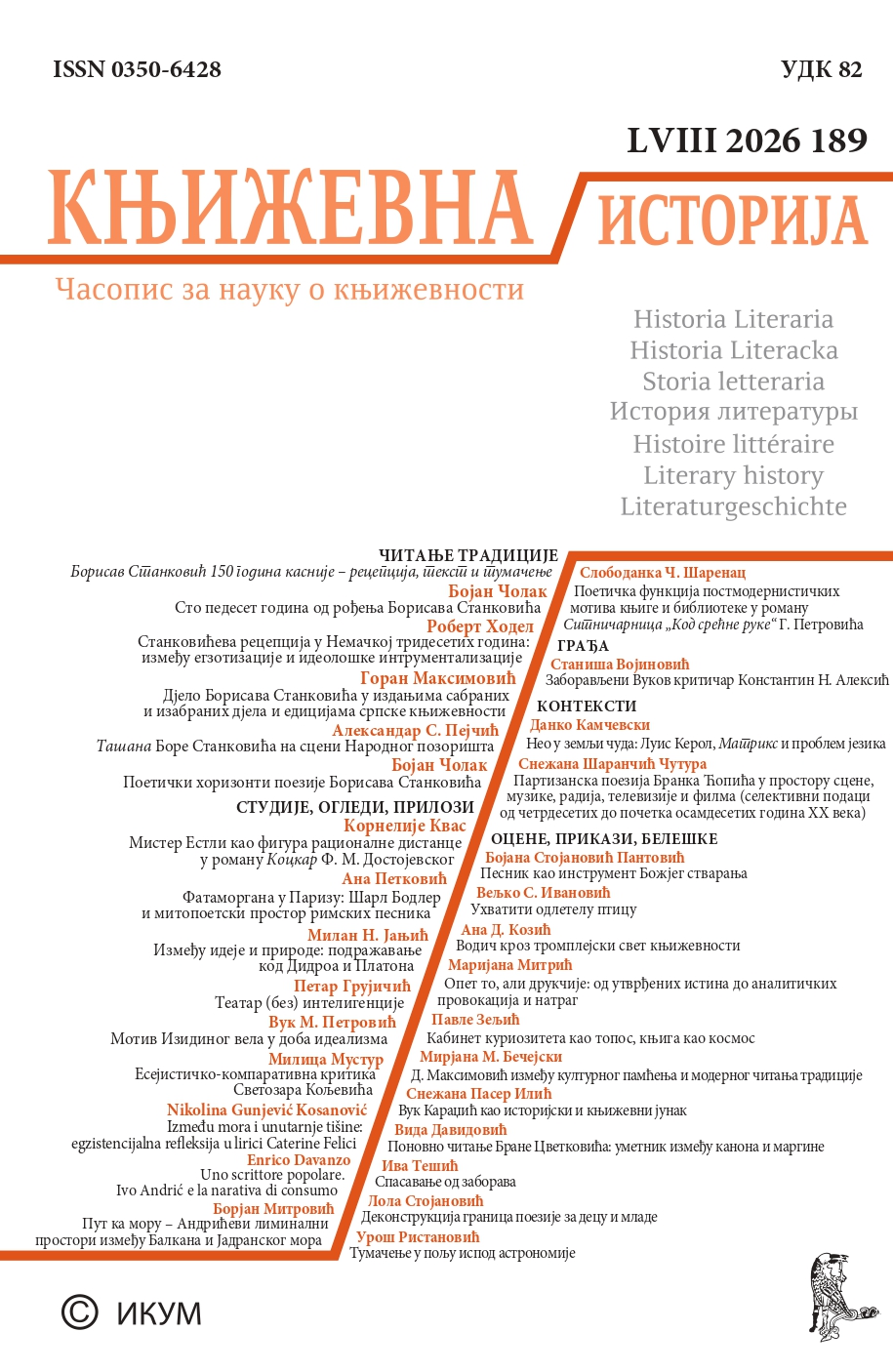
Фатаморгана у Паризу: Шарл Бодлер и митопоетски простор римских песника
Сажетак
У раду се анализира утицај римске поезије на лирику Шарла Бодлера, посебно у песми Сплин 2 која се у научној литератури најчешће упоређује са Хорацијевом одом 3.30. Аутор текста настоји да ову песму посматра у ширем контексту поетских утицаја у грчкој и римској лирици, у контексту античке књижевне критике и ликовних уметности у доба антике и у новом веку. Лирски идентитет у Сплину 2 постепено се изграђује у метафори сложеној од низа хомеосемичних слика смрти и разградње. Ове слике евоцирају однос смрти, пролазности и вечности у различитим уметничким кодовима, док је њихов међусобни однос условљен хијерархијом коју је Бодлер установио у есеју Сликар модерног живота. Евокација кључних митопоетских и историјских локуса у Катуловим, Вергилијевим, Хорацијевим и Овидијевим песмама, митолошка контаминација и алузије на учење о узвишеном стилу у расправи Псеудо Лонгина, доприносе изједначавању идентитета и спајању митопоетског, историјског и „личног“ хронотопа у Сплину 2 и у Цвећу зла.
Референце
Charles Baudelaire. OEuvres completes. T. 1. Claude Pichois (éd.). Paris:
Gallimard, 1975.
Charles Baudelaire. OEuvres completes. T. 2. Claude Pichois (éd.). Paris:
Gallimard, 1976.
Euripide. Tragédies: Tome 8, 2e partie. Fragments de Bellérophon à Protésilas.
François Jouan, Herman Van Looy (ed.). Paris: Les Belles Lettres, 2024.
Greek Lyric. Volume 3: Stesichorus, Ibycus, Simonides, and Others. David
A Campbell (ed.). Cambridge, Massachusetts / London: Harvard
University Press, 1991.
Iambi et elegi Graeci ante Alexandrum cantati. Vol. 2. Martin L. West (ed.).
Oxford: Clarendon Press 1971–72.
Q. Horatius Flaccus: Opera. David R. Shackleton Bailey (ed.). Berlin: Walter
De Gruyter, 2008.
Longinus. On the Sublime. Donald A. Russell (ed.). Oxford: Oxford University
Press, 1982.
Ovidius. Ex Ponto libri quattuor. J. A. Richmond (ed.). Leipzig: Teubner,
Ovidi Nasonis Tristia. Johan Barrie Hall (ed.). Stuttgart / Leipzig: Teubner
Philostratus, Imagines; Callistratus, Descriptions; Arthur Fairbanks (transl.)
W. Heinemann, G. P. Putnam’s Sons: London / New York 1931.
The Works Of Algernon Charles Swinburne: with an introduction by Laurence
Binyon, and bibliography. Wordsworth Editions: Ware 1995.
Borbonus, Dorian. Columbarium Tombs and Collective Identity in Augustan
Rome. Cambridge: Cambridge University Press, 2014.
Braund, David. Scythian Laughter: Conversations in the Northern Black
Sea Region. Meetings of Cultures in the Black Sea Region: Between
Conflict and Coexistence (Black Sea Studies 7). P. G. Bilde, J. H. Petersen
(eds.). Aarhus: Аarhus University Press, 2008. 347–367.
Commager, Steele. The Odes of Horace: A Critical Study. New Haven and
London: Yale University Press, 1962.
de Jonge, Casper C. Longinus 36.3: The Faulty Colossus and Plato’s Phaedrus.
Trends in Classics 5 (2013): 318–340.
Fitton Brown, Anthony D. The Unreality of Ovid’s Tomitan Exile. Liverpool
Classical Monthly, 10. 2. (1985): 19–22.
Ford, Andrew. Homer: The Poetry of the Past. Ithaca and London: Cornell
University Press, 1992.
Greitschus, Sven. Idealist Epistemology and the Baudelairean Experience
of Modernity: Fragments in the Dark. Berlin / Bruxelles / Chennai /
Lausanne / New York / Oxford: Peter Lang, 2024.
Griffith, Drew R. The Origin of Memnon. Classical Antiquity, 17. 2 (1998):
–34.
Havener, Wolfgang. Imperator Augustus: Die diskursive Konstituierung der
militärischen per sona des ersten römischen princeps. Stuttgart: Franz
Steiner Verlag, 2016.
Holleman, A. W. J. Ovid’s Exile. Liverpool Classical Monthly, 10. 3 (1985): 48.
Jauss, Hans Robert. 1982. The Poetic Text within the Change of Horisons of
Reading: The Example of Baudelaire’s ‘Spleen II’. Toward an Aesthetic of
Reception (trans. Timothy Bahti). Minneapolis: University of Minnesota.
–185.
Keith, Alison. Frigid Landscapes and Literary Frigidity in Ovid’s Exile
Poetry. Ovid, Death and Transfiguration. Joseph Farrell, John F. Miller,
Damien P. Nelis, Alessandro Schiesaro (eds.). Leiden / Boston: Brill,
1331–53.
Lowrie, Michèle. Spleen and the Monumentum: Memory in Horace and
Baudelaire. Comparative Literature, 49. 1 (1997): 42–58.
Panofsky, Erwin. Studies in Iconology: Humanistic Themes in the Art of the
Renaissance. New York: Oxford University Press, 1939.
Platt, Verity. Silent Bones and Singing Stones: Materializing the Poetic
Corpus in Hellenistic Greece. Tombs of the Ancient Poets:Between
Literary Reception and Material Culture. Nora Goldschmidt, Barbara
Graziosi (eds.). Oxford: Oxford University Press, 2018. 21–49.
Starobinski, Jean. Memory of Troy. The Hudson Review, 59. 1 (2006): 15–41.
Stechow, Wolfgang. The Winter Landscape in the History of Art. Criticism,
(1960). 175–189.
Svenbro, Jesper. Phrasikleia: Anthropologie de la lecture en Grèce ancienne.
Paris: La Découverte, 1988.
Wachter, Rudolf. The Origin of Epigrams on ‘Speaking Objects’. Archaic and
Classical Greek Epigram. Baumbach, Manuel, Petrovic, Andrej, Petrovic
Ivana (eds.). Cambridge: Cambridge University Press, 2010. 250–260.
Woodman, Tony. Exegi monumentum. Horace, Odes 3.30. Quality and
Pleasure in Latin Poetry. Tony Woodman, David West (eds.). Cambridge:
Cambridge University Press, 1974. 115–128.
Vernant, Jean-Pierre. Mythe et pensée chez les Grecs. Études de psychologie
historique. Paris: François Maspéro, 1965. (= Vernant, Jean-Pierre. 2006.
Myth and Thought among the Greeks. J. Loyd, J. Fort (trans.). New York:
Zone Books.)
Сва права задржана (c) 2026 Ana Petković

Овај рад је под Creative Commons Aуторство-Nекомерцијално-Без прераде 4.0 Интернационална лиценца.
Аутори који објављују у часопису сагласни су са следећим условима:
- Аутори задржавају своја ауторска права и додељују часопису ексклузивно право првог објављивања научног рада који је истовремено лиценциран под Creative Commons Attribution-NonCommercial-NoDerivatives 4.0 International (CC BY-NC-ND 4.0), што омогућава другима да деле ту интелектуалну својину искључиво у научноистраживачке сврхе уз одговарајуће цитирање на аутора и часопис.
- Аутори имају права да деле своје радове у одговарајућим институционалним репозиторијумима, као и да их накнадно објављују прерађене и уз дораду, али уз обавезну потврду Књижевне историје и напомену о првом објављивању у овом часопису.
- Ауторима је дозвољено, чак се и подстичу да деле радове вирално (нпр. на друштвеним мрежама попут ResearchGate или Academia), што може довести до продуктивне размене научних информација, као и до веће видљивости и цититираности аутора и часописа. (Погледајте The Effect of Open Access).